
SynoGut Review 2026: Ingredients, Label Transparency & Verdict
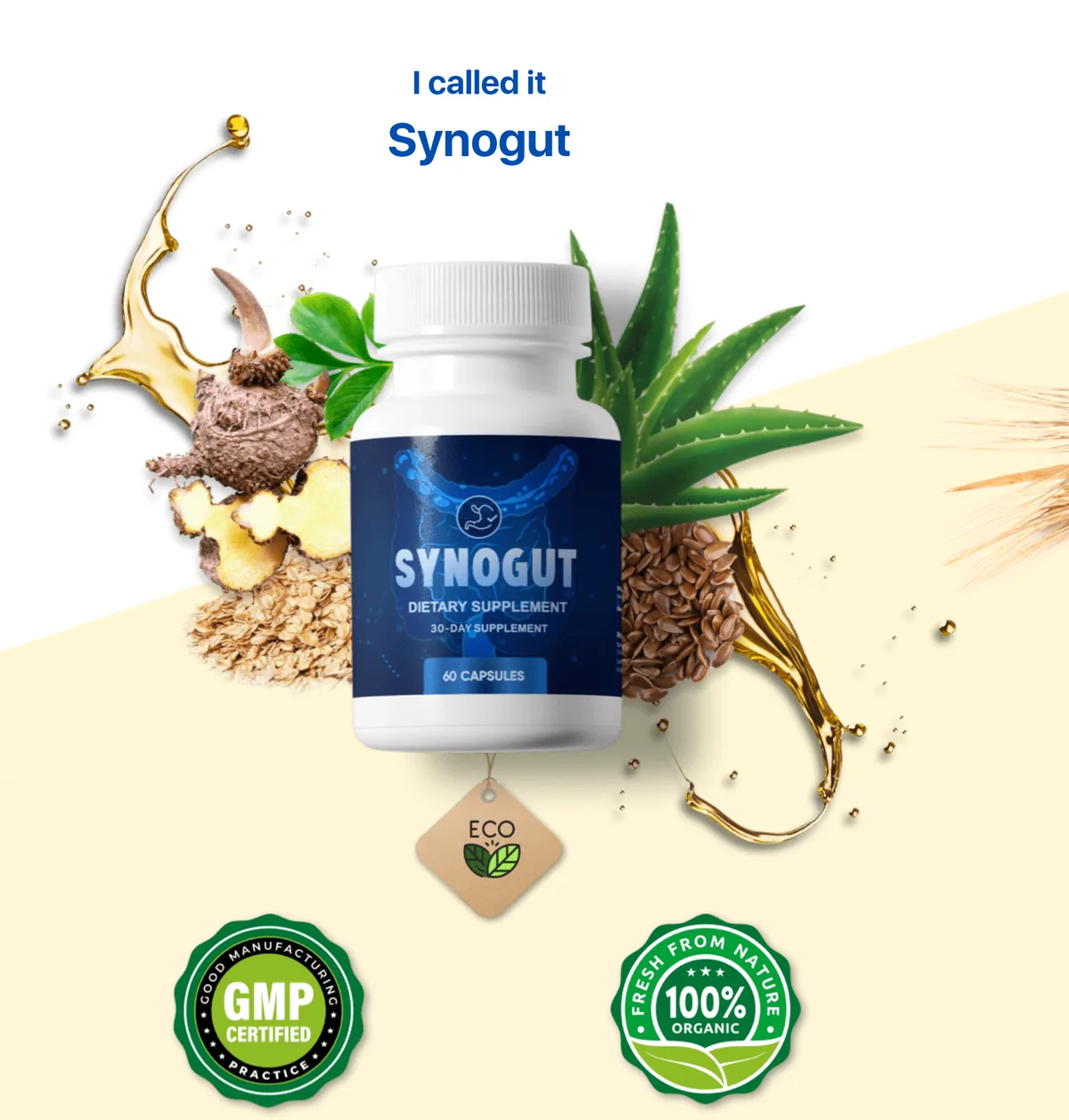
SynoGut
What We Like
- Ten well-known gut-health ingredients in one capsule
- 60-day money-back guarantee, even if the bottle is used
- Made in the USA in an FDA-approved, GMP-certified facility
- Free US shipping and per-bottle price drops to $49 on the 6-bottle pack
- Non-GMO and free of stimulants, per the manufacturer
What Could Be Better
- All ten ingredients share a 1.5g blend with individual doses hidden
- No CFU count disclosed despite probiotic marketing
- The product itself has not been studied in clinical trials
- Contains tree nuts and gelatin, so it's not vegan or nut-allergy safe
- Sold only through ClickBank; buyers pay return shipping on refunds
Table of Contents
- What Is SynoGut?
- SynoGut Ingredients and the Proprietary Blend
- What the Label Does and Doesn’t Disclose
- Clinical Evidence and Third-Party Testing
- SynoGut Dosage and How to Take It
- SynoGut Pricing, Packages, and Where to Buy
- SynoGut’s 60-Day Money-Back Guarantee
- Safety, Allergens, and Who Should Avoid SynoGut
- What Other Reviewers Say About SynoGut
- SynoGut vs. Alternatives: Is It Worth It?
- Frequently Asked Questions
- Final Verdict: Is SynoGut Worth It?
SynoGut is a digestive-health capsule that markets itself as an all-in-one fix for bloating, irregularity, and general gut discomfort. It combines fiber, a probiotic, and a clay binder in a single formula — but the way those ingredients are dosed is the central question this review tries to answer. Here we break down what is actually on the label, what the sales page leaves out, the real pricing and refund terms, and whether SynoGut is worth buying over simpler, more transparent alternatives.
What Is SynoGut?
SynoGut is a capsule-based digestive supplement created by Samuel Bart, who describes himself on the official page as a 49-year-old living in Nashville, Tennessee. The sales pitch frames it as a straightforward way to support digestion without overhauling your diet, and the product is positioned for adults dealing with bloating, irregularity, or slow digestion.
The formula lists 10 ingredients: psyllium, bentonite clay, black walnut, oat, flaxseed, prune, aloe vera, L. acidophilus, apple pectin, and glucomannan. That is a recognizable mix of soluble and insoluble fiber (psyllium, oat, flaxseed, apple pectin, glucomannan), a probiotic strain (L. acidophilus), a binding clay (bentonite), and plant extracts. On paper it reads like several digestive products folded into one capsule, which is exactly how the manufacturer sells it.
The company behind the product is identified in third-party reviews as Synogut LLC, and the supplement is made in the USA in an FDA-approved and GMP-certified facility — a manufacturer claim rather than an independent certification. The manufacturer also states the capsules are non-GMO and not habit forming.
SynoGut Ingredients and the Proprietary Blend
The ten-ingredient list looks impressive on the surface, but the way it is disclosed is the single most important thing to understand before buying. All 10 ingredients are grouped together into one proprietary blend, and the entire blend weighs 1.5 grams per serving. The serving is 2 capsules.
The problem with a single blend is that the label does not disclose individual amounts. A buyer can see that all ten ingredients are present, but there is no way to know whether each one is present at a clinically meaningful dose or only in trace amounts. That matters because the entire blend weighs just 1.5 grams, shared across all ten, so no single ingredient can be present at a large dose.
The probiotic point is even sharper. The formula includes L. acidophilus, which the marketing leans on heavily, but the CFU (colony-forming unit) count is not disclosed on the label. Without a CFU count, a buyer cannot assess whether the probiotic dose is meaningful at all, since probiotic potency is normally expressed in CFUs.
What the Label Does and Doesn’t Disclose
The supplement facts panel is where the gaps become concrete. The label confirms the 1.5-gram proprietary blend with a 2-capsule serving and confirms that individual amounts are not disclosed. It also confirms the CFU count is not disclosed.
Beyond the active blend, the “other ingredients” list is gelatin, magnesium stearate, and silicon dioxide. The gelatin capsule means SynoGut is not vegan or vegetarian. That is a meaningful detail the sales page does not foreground, and it matters to anyone buying a “natural” supplement with plant-based expectations.
The label also carries a tree-nut warning. Because SynoGut contains black walnut hull, it is labelled “Contains Tree Nuts”. People with nut allergies need to steer clear, and the manufacturing facility processes several other common allergens — milk, soy, wheat, egg, peanuts, fish, and shellfish — which introduces cross-contamination risk for anyone with severe allergies.
Clinical Evidence and Third-Party Testing
The most important honesty test for any supplement is whether the specific product has been studied. SynoGut does not appear to have been studied in any clinical trials. That is a standard situation for a multi-ingredient proprietary blend, but it means the effectiveness claims rest entirely on ingredient-level research rather than on evidence that this exact formula works.
The official references page leans on ingredient-level studies, including a randomized, controlled trial of bentonite (beidellitic montmorillonite) for irritable bowel syndrome, cited as PMID 15709995. That is real research on a related ingredient, but it is not a trial of SynoGut itself, and bentonite is only one of ten ingredients in the blend.
The manufacturer states that a third party verified the purity of its ingredients, though the specific laboratory is not named, so this is a claim rather than a published certificate. Independent reviewers are more cautious: the medical-reviewed site Illuminate Labs, whose review was checked by Auren Weinberg, MD, concluded that it does not currently recommend SynoGut.
SynoGut Dosage and How to Take It
The published dosing instructions are not perfectly consistent across sources, which is itself worth noting. Consumer Health Digest describes the dose as 2 capsules daily, one in the morning and one in the evening. Wellness Digest, reviewed by a registered dietitian, describes it as 2 capsules once daily with a meal, and warns not to exceed 2 capsules within 24 hours.
Both agree on the core number: a serving is 2 capsules, with a daily maximum of 2 capsules within 24 hours. Each bottle contains 60 capsules, which at 2 capsules per day works out to a 30-day supply — consistent with the manufacturer’s description of a single bottle as a 30-day supply.
One caution that appears consistently is medication spacing: the label advises taking SynoGut at least 2 hours apart from any prescription or over-the-counter drugs. Because psyllium and glucomannan are fibers, they can slow or alter the absorption of medications taken at the same time. The manufacturer also advises using the product for at least 3 months before judging whether it works, which is a longer commitment than the single-bottle purchase covers.
SynoGut Pricing, Packages, and Where to Buy
SynoGut is sold in four package tiers, all through the official website. Here is the full breakdown:
| Package | Total | Per bottle | Supply |
|---|---|---|---|
| 1 bottle | $69 | $69 | 30 days |
| 2 bottles | $158 (was $358) | $79 | 60 days |
| 3 bottles | $207 (was $537) | $69 | 90 days |
| 6 bottles | $294 (was $1074) | $49 | 180 days |
Free shipping is offered on orders, and the 6-bottle package adds 3 free bonus guides with claimed retail values of $55, $54, and $54.
The retailer is ClickBank, and the manufacturer states SynoGut is available only on the official page and not sold anywhere else. That claim is contradicted by several third-party reviews, which note the product is also listed on Amazon. The practical takeaway is that the official site is the purchase channel the manufacturer controls, and ClickBank is the checkout processor behind it.
SynoGut’s 60-Day Money-Back Guarantee
SynoGut is backed by a 60-day money-back guarantee. The manufacturer states it will give a full refund within 60 days even if the bottle has been used up, which is a generous-sounding term on the surface.
The fine print is where it gets less generous. The official refund policy clarifies that the 60-day window begins from the moment the package is delivered, not from the order date. Refunds take 5 to 10 days to process, and — the key caveat — the seller does not cover return shipping costs. In other words, the “risk-free” guarantee still leaves the buyer paying to ship the bottle back to the return address in Aurora, Colorado.
Support is reachable by email at contact@synogut.com, by a toll-free order line at 1-800-390-6035, and by an international line at +1 208-345-4245, with a self-service order portal at clkbank.com.
Safety, Allergens, and Who Should Avoid SynoGut
SynoGut carries two allergen flags that rule it out for specific groups. First, it contains tree nuts because of the black walnut hull, so anyone with a tree-nut allergy should avoid it. Second, the capsule is made of gelatin, so it is not vegan or vegetarian. On top of that, the facility also processes milk, soy, wheat, egg, peanuts, fish, and shellfish, which is a consideration for anyone with severe allergies.
The medication interaction point is worth repeating: the label says to take SynoGut at least 2 hours apart from medications. Anyone on regular prescription medication should factor that spacing into their routine and, as always, check with a doctor first.
The standard FDA disclaimer applies: the statements on the product have not been evaluated by the FDA, and the product is not intended to diagnose, treat, cure, or prevent any disease. The manufacturer describes the capsules as non-GMO and not habit forming, which are reassuring claims but come from the seller rather than an independent certifier.
What Other Reviewers Say About SynoGut
Third-party editorial reviews are notably warmer than the independent, medically reviewed take. Consumer Health Digest gives SynoGut 4.8 out of 5, based on 16 reviews and a review by Felicia Newell, RD, CPT. Wellness Digest likewise rates it 4.8 out of 5, with its review checked by Ashley White, MPH, RDN, LDN.
The counterweight comes from Illuminate Labs, which is a test-heavy independent outlet. Its medical reviewer, Auren Weinberg, MD, reviewed the same product and landed on the opposite conclusion: it does not currently recommend SynoGut. The split is instructive — the high affiliate-style scores tend to repeat the sales pitch, while the independent review focuses on the undisclosed doses and the lack of a product-specific trial.
SynoGut vs. Alternatives: Is It Worth It?
The most useful comparison for a buyer is not between SynoGut and a competitor blend, but between SynoGut and what it is trying to replace. There is also a version discrepancy worth knowing about: the SynoGut listing on Amazon shows a different formulation whose first ingredient is a probiotic at a 40 billion CFU dose. Illuminate Labs points out that the ingredients on the official website — flaxseed, prune, and bentonite clay — do not appear in the Amazon ingredient list at all, and that two of the Amazon ingredients are misspelled (“rice flower” instead of “rice flour” and “l-lucine” instead of “l-leucine”). The two listings appear to be different products sharing a name, which is a red flag for consistency.
For the ingredients themselves, simpler options often make more sense. Psyllium is available as a single-ingredient fiber with a disclosed per-serving dose, so a buyer knows exactly how much fiber they are getting. The same logic applies to the probiotic: a standalone probiotic that states its CFU count addresses the disclosure gap that SynoGut leaves open. Both are cheaper per ingredient and far more transparent.
Frequently Asked Questions
What is SynoGut and what does it do?
SynoGut is a capsule-based digestive-health supplement created by Samuel Bart. It combines fiber, a probiotic, and a clay binder into one formula, marketed for bloating, irregularity, and general digestive support.
What are the SynoGut ingredients?
The formula lists 10 ingredients: psyllium, bentonite clay, black walnut, oat, flaxseed, prune, aloe vera, L. acidophilus, apple pectin, and glucomannan. All ten share a single 1.5-gram proprietary blend, and individual doses are not disclosed.
How do you take SynoGut, and what is the dosage?
The serving is 2 capsules, described either as one in the morning and one in the evening or as 2 capsules once daily with a meal, with a maximum of 2 capsules within 24 hours. The label advises taking it at least 2 hours apart from medications.
How much does SynoGut cost, and where can I buy it?
A single bottle costs $69 for a 30-day supply. Multi-bottle packages run $158 for 2, $207 for 3, and $294 for 6, with per-bottle prices dropping to $49 on the 6-bottle pack. It is sold through ClickBank on the official website.
What is the SynoGut money-back guarantee?
It is a 60-day money-back guarantee, with a full refund offered even if the bottle is used. The window runs 60 days from delivery, processing takes 5 to 10 days, and the buyer pays return shipping.
Does SynoGut have any side effects or allergens?
The product contains tree nuts from the black walnut hull and uses a gelatin capsule, so it is not suitable for people with nut allergies or for vegans. The manufacturing facility also processes milk, soy, wheat, egg, peanuts, fish, and shellfish.
Is SynoGut clinically tested?
No. SynoGut itself does not appear to have been studied in any clinical trials. The manufacturer cites ingredient-level research, including a bentonite trial for irritable bowel syndrome (PMID 15709995), but that is not a study of the SynoGut formula.
Final Verdict: Is SynoGut Worth It?
Our overall rating is 6.3 out of 10.
| Category | Our score |
|---|---|
| Effectiveness | 6/10 |
| Value | 6/10 |
| Ease of use | 8/10 |
| Support | 6.5/10 |
SynoGut gets the convenience fundamentals right. It is a single capsule that bundles fiber, a probiotic, and a clay binder into an easy 2-capsule routine, and it is backed by a genuine 60-day guarantee and free US shipping. For someone who simply wants a low-effort, all-in-one digestive capsule and is comfortable with the trade-offs, it is a functional option.
The trade-offs are substantial, though. All ten ingredients share a 1.5-gram blend with hidden individual doses, the probiotic’s CFU count is not disclosed, and the product itself has never been clinically tested. The tree-nut and gelatin content rules out vegans and anyone with a nut allergy, and the refund process requires the buyer to pay return shipping to Aurora, Colorado. For most people, a standalone psyllium fiber with a disclosed dose or a probiotic that states its CFU count will deliver similar upsides with far more transparency and less cost. If you want to compare it against other supplements, browse the health-fitness category, read our ProDentim review for another evidence-based breakdown, and see how we evaluate products in our testing methodology.

This review may contain affiliate links. If you buy through them, we may earn a commission at no extra cost to you. Learn how we test.
Related Reviews
LeanBiome Review 2026: Ingredients, Science & Honest Verdict
Our 2026 LeanBiome review breaks down the full ingredient label, the science behind each strain, real pricing, side effects, and…
Nitric Boost Ultra Review 2026: Ingredients, Pricing & Verdict
Honest Nitric Boost Ultra review: the 8 ingredients, undisclosed doses, real bundle pricing, the 60-day guarantee, and who should…
Quietum Plus Review: Ingredients, Price & Honest Verdict
An evidence-based review of Quietum Plus: its 18-ingredient formula, bundle pricing, 60-day guarantee, and what the research actu…